The Jupiter Cycles
Optimistic, expansive and meaning-seeking Jupiter is now in the sign of Leo, where it will remain until 11th August 2015. Excitement is already high; try googling ‘Jupiter’s shift into Leo’ and you’ll see what I mean. My impression from talking to people, and dipping into social media, is that we are all looking for a bit of light relief from what has been a pretty bad news year thus far.
So – what is this shift likely to mean for you and me? In this two-part article, I will first of all introduce the Jupiter cycle in general. In the second part, we will look in some detail at the Jupiter cycle in relation to its traverse of the sign of Leo. It’s important to colour theory with some lively examples of what actually happens to real people when those shifts take place. I already have some interesting material to share. Let’s go!

Part One: what is the Jupiter Cycle?
As ever, it is important at the outset of a general article to stress that one can only really judge in detail what the essence of any planetary shift is likely to be from consideration of the whole horoscope or birth chart. However, it is certainly possible to sketch out a broad picture which can offer some perspective: both to readers with some astrological knowledge, and to those of you with none who are curious to know more.
Each of the planets, travelling through the twelve signs of the zodiac as viewed from Earth, has a cycle of differing length. Pluto, currently in Capricorn, will take 248 years to traverse the 360 zodiacal degrees, returning to that sign long after we are all dead and gone! Saturn’s cycle, on the other hand, is a much shorter 29/30 years. Currently in Scorpio, dredging up all kinds of sexual scandal from its previous traverse of that sign in the 1980s, it offers us all the famous Saturn Return, returning to the place it occupied at our birth when we are 29/30 years of age – inviting us all to grow up.
Jupiter and Saturn together form a symbolic, complementary whole: as its cycle unfolds, Saturn helps us to be realistic and to set limits without which no maturation or growth can take place. Jupiter creates contrast and balance to this. It energises that optimistic, expansive part of us which reaches out to the pleasure of new experience, new learning and understanding. Its natural exuberance can make life a fun, joyful experience.
It can also cause us to over-reach our limits, expect more than life can realistically deliver. That facet needs to be watched carefully when Jupiter is very active in our lives…
Jupiter’s cycle is 11-12 years: 11.6 years to be exact. It’s an easy one to track, being accessible both to those of you who know some astrology and those of you who don’t. Everyone can track though their lives, measuring the Jupiter cycles: Jupiter returns to its location in your birth horoscope at 11/12 years of age, 23/4, 35/6, 47/8, 59/60, 71/2, 83/4 in a currently average lifetime.
What do we look for in the Jupiter cycle? In essence, the start of each cycle represents the opening out of a whole new learning period, whose archetypal purpose is to expose us to new experience, new learning – all kinds of travelling within both inner and outer life.
Real life flesh on symbolic bones…
These experiences may and do vary hugely from one person to another, taking their flavour from the zodiacal sign and house in which Jupiter was located when you were born.
At 23/24 (Jupiter in Sagittarius in 9th house) you might take off to Australia to do a postgraduate Diploma in Adult Education. Your friend (Jupiter in Capricorn in 6th house) might not travel anywhere, but concentrate on mastering a new skill like carpentry which enables him after a few years’ apprenticeship to set up his own business. In the meantime, my neighbour down the street (Jupiter in Cancer in 5th house) might marry at 23/4 and have three children in rapid succession before the age of 30. In a real-life example, Alexa said: “My second Jupiter return, aged 24, coincided with me buying a house – natal Jupiter is in Cancer, which is appropriate, of course, and the house was bigger (Jupiter) than we needed for just the two of us, so we could have space for lodgers.”
These are very different branches, Jupiter in differing signs and houses of the zodiac at birth: but the same underlying principle of expansion and growth of experience, understanding, and (hopefully!) some wisdom, shines through them all.
You can also detect the archetypal lifelong themes provided via Jupiter’s placing by sign and house in your personal horoscope, as you follow the Jupiter cycle’s unfolding throughout your lifetime. For example, I have Jupiter in Scorpio in the third house of my natal horoscope. It’s not hard to work out from this (and Jupiter’s strong links to most of the planets in that horoscope!) that an intense preoccupation with gathering and sharing all kinds of information and placing it in contexts which expand one’s understanding of life’s deeper meanings, might be rather important to me…
The Jupiter cycle: unfolding in one lifetime
At 11-12, I passed the “Quali” (the long defunct Scottish entrance exam to determine one’s level of entry to secondary education). At 23-4, I completed a post-graduate Diploma in Education, having already been an adult education teacher for two years. At 35-6, I studied for and passed my first astrology qualification, the Certificate of the Faculty of Astrological Studies (UK), prior to beginning a career as an astrologer.
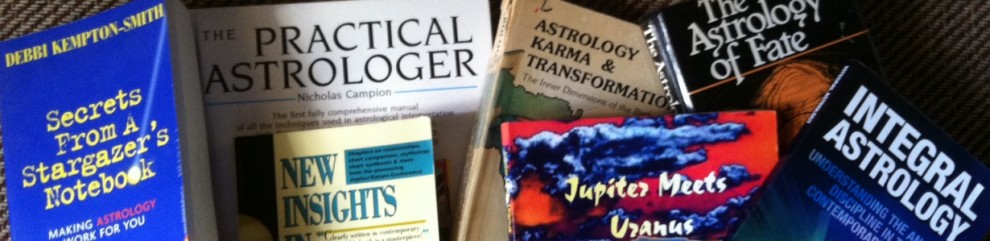
At 47-8, I began the Diploma in Psychological Astrology, studying with Liz Greene and the late Charles Harvey at the Centre for Psychological Astrology in London. In completing this course, I commuted by plane for three years, earning myself the nickname of “The Flying Scot”. The year after the 59-60 Jupiter Return, I stepped into cyber-space via “Writing from the Twelfth House” my main blog. My first book, a research study called “Jupiter Meets Uranus”, was published the following year.
Perhaps this personal account will encourage you to track through a few of your Jupiter cycles, and see that there is indeed a thematic unfolding of a specific kind of experience…
Fate, free will…or what?
The question of what the balance is between fate and free will has preoccupied humans for millennia. It remains unresolved. However, as an astrologer it is important to have a view. Decades of astrological practice; much reading especially in recent years including what I can grasp of probability theory and chaos theory; my own efforts to become a more conscious person: these have all led me to the view (not original at all – many astrologers take this standpoint!) that there are certain givens in this life, as shown by the characters standing on a person’s life stage when the horoscope is drawn up. Those characters, the horoscope’s symbolic, archetypal patterns, are ours for life.
However, the evidence of observation and experience appears to suggest this vital point: the more conscious we can become of what our motivations and drives are, and how they impact on our inner and external life, the wider becomes the range of possible avenues of expression to which we can have access in choosing how to make our particular life’s drama as positive and creative as possible.
Bearing this in mind, let’s return to the Jupiter cycle and see how we might work creatively and consciously with its 11-12 year periods.
Working with cycles
All life cycles, whether we at looking at a gnat, a human, or a galaxy, go through the same process: seeding, germinating, sprouting, flowering, ripening, harvesting, dying back in preparation for the new. So it is with the planetary cycles.
Think of the tiny monthly cycle of the Sun and Moon. The New Moon takes place in darkness. Only when that first magical waxing crescent appears after 2-3 days, does the energy of the cycle begin to build. After a week, first quarter, things are taking shape. At full moon, the cycle’s energy is in full light, at its most obvious. A week later, on the waning square, the Moon is shrinking, the month’s energy on the wane. Then the last, waning crescent precedes moondark, those 2-3 days in which the energy of the completed cycle sinks back into the Void, waiting for the energy of the next New Moon to arise.
Applying the same template to the 11-12 year cycle of Jupiter, it takes a year or so for the initial upsurge of desire for new expansive challenges to stabilise and take definite form.
Jupiter in action: a real-life example
Let’s use the person with Jupiter in Sagittarius in the 9th House as our example. At the age of 23, off she goes to Australia, completes her Diploma, and obtains a good teaching job in Melbourne. She works there for a couple of years, then relocates to Sydney (first quarter phase, Jupiter now in Pisces) since she wants to take up sailing and she has a friend there who runs a sailing school.
Three years later (full moon phase, Jupiter in Gemini) she agrees to take on a teaching job at the sailing school where she has been a student. Another three years go by, and she begins to become dissatisfied and critical (last quarter phase, Jupiter now in Virgo). She is becoming bogged down in admin and paperwork. Not her style!
She puts less and less commitment into her job, and after over ten years in Australia, she has itchy feet again (moondark). Nearly twelve years after arriving, full of enthusiasm, she is off to work in the Greek Islands. She has fallen in love with a Greek Australian and decides to return with him to his home island of Rhodes. She is nearly thirty-six years old.A new Jupiter cycle is about to begin…
Working with our Jupiter cycles
I’ve always found that astrology students and clients are fascinated when you unfold their major cycles with them, as well as finding it helpful in understanding the unfolding pattern of their lives. The Jupiter cycle is a particularly easy one to which to connect. The rhythm of the cycle, looking back, can usually be tracked. In the last year or two before a new 11-12 year period begins, one can generally perceive a certain dissatisfaction, boredom, loss of any great interest, and desire for a new challenge in the sphere of life indicated by the sign and house placement of Jupiter natally. If Jupiter is a very strongly placed and emphasised ‘character on the stage’, the overall effect is of course amplified.
With Jupiter in Scorpio in the third house, I clearly recall my boredom, restlessness, and desire for a new educational project towards the end of my fourth Jupiter cycle when I was forty-six or forty-seven. Alexa, with her Jupiter in Cancer, bought a house at the start of the second Jupiter cycle when she was twenty-four, “… bigger (Jupiter) than we needed for just the two of us, so we could have space for lodgers.”
Are you a year or two into a new Jupiter cycle? Or three years into it? After five or six years, the cycle is at its Full Moon phase, its peak of energy. By nine years, impetus generally is on the wane, and restlessness setting in. By the Moondark phase of the cycle, it really feels like time for a new project, a new venture. But you know, if you are familiar with this cycle’s rhythm, that it will probably be another couple of years before the new idea has taken shape and translated itself into a fresh, exciting direction.
One of the great gifts of astrological knowledge is the help it offers in setting our sails, metaphorically speaking, to the prevailing winds of our lives. It is useful to get to know your Jupiter cycle, in planning those times in life when your Spirit is calling you to open up your life to new experience. I do hope this introductory article has given you some useful food for reflection – and impetus to action!
Part Two: Jupiter in Leo.
It would be helpful in the meantime if any readers feel like sharing their experiences of Jupiter cycles. In this way, we all expand our understanding…Thanks!

Zodiac
2000 words copyright Anne Whitaker 2014
Licensed under Creative Commons – for conditions see Home Page






 Astrology: Questions and Answers