Tag Archives: Zodiac

Questioning popular astrology (1) : Anne Whitaker challenges media astrologer Victor Olliver

In recent months I’ve had the pleasure, thanks to Facebook,  of ‘meeting’ astrologer Victor Olliver, the new Editor of UK’s long established Astrological Journal and star sign columnist for The Lady magazine. As well as sharing a love of astrology (and a very black sense of humour), we have already collaborated on several writing projects. This is proving to be great fun as well as being most stimulating.

One of the things I like about Victor is his love of a good argument. So, I decided he was just the person with whom I could raise my various doubts about the merits of popular astrology. I wrote to him, airing my questions and objections at some length. Here they are. Victor’s response will follow in the next post.

Dear Victor

I have always refused invitations to write popular astrology columns, feeling that to do this would be to throw my lot in with the ‘entertainment wing’ of astrology. Those of us who are trained and experienced astrologers know that there is a profound, ancient and some would say sacred art hidden behind this popular mask. Some of us who know this – like yourself – still manage to combine in-depth astrology practice with writing astrology for the popular press, apparently without feeling any particular discomfort at straddling both worlds.

I suppose my big problem is that the astro-dismissers are almost invariably people who have never gone into astrology in any depth, because they never get past the shallow waters of popular astrology where they find plenty of ammunition for their scorn, much of it valid when you have a look around a lot of the astro-stuff published in the world’s media.

Personally, I see off any astro-dismissers by fixing them with a keen gaze, enquiring very politely whether they have ever studied the subject in depth, and responding to their evasions (very few direct admissions of ignorance are forthcoming) by suggesting they go away to study the subject in depth for a couple of years then come back to resume our conversation. As a ‘serious’ astrologer, I have to admit to feeling defensive when asked what I do, invariably saying that I do in-depth stuff which has very little to do with the astrology to be found in the popular press.

Is there any way round this problem? Should we all just accept that astrology of whatever shallowness or depth will simply never be taken seriously within our current materialist culture, and cheerfully get on with it, whatever kind of astrology we do? Would it be helpful if ‘serious’ astrologers who also do popular astrology were to admit that for many of us, the gap between the public face and the private reality of astrology and its practice is a very hard one to bridge?

What are your views on this, Victor? How do you justify occupying both worlds to yourself and others – and what do you suggest those of us do (apart from go boil our heads) who feel uncomfortable at having our commitment to serious, in-depth work ridiculed by people who have taken their stance from perusing the shallow material available in much of the popular press?

Do feel free, dear Readers,  to leave some observations  of your own on this contentious issue – as long as you understand that anything abusive will be binned without mercy!

To read Part Two, click HERE


Mars being reasonable - must be in Libra....

Mars being reasonable …eh?!

********

600 words copyright Anne Whitaker  2015

Licensed under Creative Commons – for conditions see Home Pag

Some thoughts on the Astrological Houses: Placidus, Equal – or what ?

Sooner or later, it dawns on the student or budding astrologer that the method of dividing the inner space in a horoscope into twelve sectors or spheres of life, known as Houses, poses some problems.
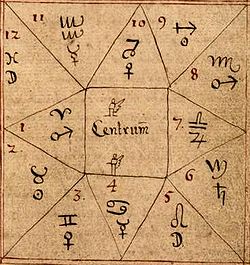
Astrological Houses

Astrological Houses

Firstly, since there are a number of different house systems – click HERE for more detail on this – which should you choose?

Secondly, to a varying degree depending on your chart, planets can move house. In my chart, for instance, by Equal House I have no less than SIX planets in the Twelfth House. When I first saw my horoscope in  Placidus houses, one planet, my ruler Mercury, had migrated to the Eleventh. O joy! I need all the help I can get here, I thought then. But, as you will soon see, it’s not as simple as that…

Then there is a further problem. In Placidus, the MC/IC axis always defines the cusp of the Tenth/ Fourth Houses. If you use Equal House, the MC/IC axis can fall through any pair of houses from the 8th/2nd to the 11th/5th. How do you deal with that?

I have worked with only two systems over the years, i.e. the most commonly used ones in the UK – Equal House and Placidus. I used Equal House from the early 1980s perfectly happily, finding that the system worked well for me. Then I changed to Placidus in 1995. I didn’t choose it for any carefully thought through philosophical or practice reasons; it was simply the system used on the Diploma course I was doing. Now, in 2015, I am moving back to using Equal again. For philosophical reasons this time, as you will see shortly.

A class experiment

Ever since a small group of my ‘old’ students persuaded me to run a refresher class for them starting last August 2014, I have really enjoyed returning to astrology teaching. Those students were all very rusty, and wanted to cover the basics again. Inevitably, the question of house division came up. Having covered the core meanings of the houses in an introductory class, we recently spent a whole tutorial looking in more detail at the issue of house division.

The methods I adopted on this occasion were twofold: firstly, I gave the class copies of their charts in Equal House to compare with their existing Placidus charts. Then I drew up a grid, of which we all had a copy. This listed all the planets, Chiron and the North Node as well as the pair of houses through which the Equal House MC/I C axis ran. Thus we could see at a glance those features which stayed the same in both systems, and which ones changed. In some charts many features changed. In others eg mine, there was very little difference.

I have always taught astrology with every student having a copy of everyone else’s horoscopes, including mine. With permissions always asked and given before the start of a course, and appropriate emphasis on confidentiality, this way of working has been very effective. It creates each class as a kind of mini qualitative research laboratory, where astrological theory can be tested out there and then, observing to what extent it manifests accurately in the nuts and bolts of the everyday lives of those present. It is a model which makes for very lively teaching…

We worked our way round everyone in the small group, including me, discussing how interpretations might change, and most importantly, how much that mattered by potentially altering the emphasis on key horoscope themes.

For instance, the Moon in one student’s horoscope changed from the Placidus Ninth house (a location she really liked for her Moon, being both a teacher and an education junkie!) to the Tenth by Equal House, which emphasised the importance of her vocational/career life but not the dimensions of teaching and learning which are both Ninth House concerns. However, we pointed out to her that this didn’t really matter in terms of overall accuracy of interpretation; she really was very well endowed with Jupiterian energy anyway, given her Moon’s trine to Jupiter in Aries, as well as her Sun’s square to Jupiter.

This was just one example in which, whatever shift we saw of planets from one house to another, there was invariably an underlying strong theme in the birth chart, so that the emphasis being slightly shifted in one context made little if any difference to the overall accuracy of interpretation of the whole horoscope. Interestingly, more than half of our small group, despite my having worked with all students with Placidus from 1995, said that they preferred the relative simplicity of the Equal House system.

In my own case, although ruling planet Mercury moved from the sociable, group-oriented Placidus 11th House to join five other planets in the reclusive Twelfth by Equal House, I have an exact semi- square from Mercury to 10th House Uranus in both systems, Uranus also strongly aspecting the Sun and Moon, so the Aquarian/Uranian/11th house ‘tone’ remains strongly emphasised. That Mercury energy also flows from the Twelfth House to an exact sextile to Neptune, and a square to Third House Jupiter in both systems. So any reclusive tendencies brought by the move are well and truly restrained by other horoscope factors!

The students could see from our small experiment something which is fundamental to the accurate reading of any horoscope: strong themes will shine through, whatever way you divide up the circle. As U.K astrologer Robin Heath so memorably observed a number of years ago: “…astrology appears more and more to behave like a hologram. You can perform almost any technique with the data, turn the chart inside out or slice it up, and still the symbolic pictures remain….” (i) Both this statement and our class experiment bore out the conclusion at which I had  arrived some time ago. It doesn’t really matter much what system you use. What you get is the same overall picture…

Horses (Houses!) for courses…

I went on to outline the way some astrologers use different house systems for different purposes. Since the Equal House system is based on the Ascendant/Descendant axis which is the axis of “… here I am in relation to you… “, this system can be used when the client in their reading wishes specifically to address matters pertaining to relationship.

Since the IC /MC axis can be seen as an arrow flowing from the person’s deepest self and origins (IC) to their future direction (MC), then issues of roots, vocation and life direction are most appropriately contemplated, some astrologers think, via the Placidus lens since that system can be seen to emphasise the MC/IC.

Also, although I have never worked with the Koch system myself, I know that some astrologers swear by the accuracy of its house cusps in plotting transits and progressions.

The Equal House MC/IC “problem”

The placing of inverted commas above gives you a clue that I do not see the shifting placement of the MC/IC axis in the Equal House system as a problem at all. Quite the opposite. I think that working with the MC/IC axis against the backdrop of either the 2nd/8th, 3rd/9th, 4th/10th, or the 5th/11th adds a layer of richness to the interpretation of the MC/IC which of course should remain just as focal and important in the Equal House system as in any other where the MC/IC  is always the cusp of the 10th/4th Houses.

For example, I have often encountered clients or students with 2nd/8th backdrops in professions involving finance and collective money, those with 4th/10th backdrops have their strong life focus on career/vocation emphasised. With 5th/11th emphasised, you often find “creative” types who work co-operatively and collaboratively in the pursuit of their careers. And in my own case, the 3rd/9th backdrop is highly appropriate since writing and higher education have been central to all the diverse vocational paths I have pursued throughout my working life.

Equal House: the return

In conclusion, the students were very keen to know why I had decided to return to working with Equal House.  For giving me the final shove in that direction I have to thank Phoebe Wyss and her excellent recent book “Inside the Cosmic Mind” . I  would urge any astrology student or practitioner to read this book if they are inclined, as I am, to perceive astrology as a ‘top down’ art whose practice and interpretation reveals us as expressing in micro form, the shifting macro patterns of the whole cosmos.

In Phoebe Wyss’ own words:

“ Archetypal astrology is an approach to astrological chart interpretation that is based on this cosmological view. The meanings of the chart factors such as  zodiac signs, houses, and planets are then seen to derive from the twelve basic categories of meaning associated with the astrological archetypes. These fundamental cosmic principles and their inter-relationships are symbolised in the geometry of the zodiac…”(ii)

Wyss’ book – which builds on the recent work of Richard Tarnas, Kieron Le Grice and other pioneers in the field of archetypal cosmology – has taken me back and re-grounded me in the basic geometry of sacred numbers, whose symbolism reflects the core shaping principles or archetypes governing the movement of energy throughout the whole cosmos. The number twelve is one of those sacred numbers.

From that symbolic, geometric perspective, dividing the inner space of the horoscope symbolically into twelve equal parts seems more appropriate than using any other house system, including Placidus, whose devising arises purely from measurements limited by the view from planet Earth in relation to the solar system in our tiny corner of space/time 

Endnotes:

(i) The Mountain Astrologer, Issue 78, April/May 1998, Letters p 11

(ii) Inside the Cosmic Mind, Phoebe Wyss, Floris Books 2014, p 93

––––––––––––––––––––––––––––––
Zodiac

  • 1600 words copyright Anne Whitaker 2015

    Licensed under Creative Commons – for conditions see Home Page
Evoking the Twelfth House…

Last summer I was most happy to have The Mountain Astrologer magazine publish my long essay ” Contemplating the Twelfth House” – a reflection on that most complex of houses, born from my own long period of Neptunian meltdown and recovery during 2001-8. It will be re-published next month in the UK’s“Astrological Journal “, after which I intend to make it available as a free downloadable pdf. 

 In the meantime, I thought some of my Followers and readers who haven’t read the essay would like a peek at the prequel, a much shorter piece in which I first featured the nature image that midwifed the eventual finished essay.

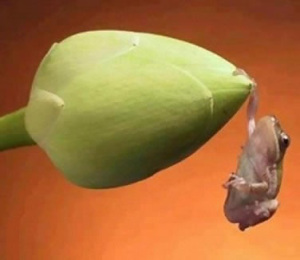
tiny-frog-on-lotus-bud

tiny-frog-on-lotus-bud

A tiny frog, barely half an inch long, flopped, dead, on the tip of a teaspoon as I gently lowered it toward the plug hole of the kitchen sink. Soon, I’d turn on the tap and its fragile little body, already liquefying, would be washed down the drain.

Yesterday, it had been leaping around, full of life, inside the  plastic refrigerator box in which I had created a little aquarium with water, moss and stones. The tadpoles which I had brought home a few weeks previously had all survived. Satisfaction and pleasure at having achieved this, however, was tempered with the growing knowledge that these delightful new pets would soon have to be returned to their original habitat.

But this little fellow would never go home.

This small incident, which occurred well over thirty years ago, offered such a poignant illustration of the transient fragility of life that it has never left my memory.

There are times when something apparently tiny and fleeting can illustrate much larger truths.

The constant dance between order and chaos, form and formlessness, being and non-being, seems to occur in all epochs and at all levels. Humans have created a range of paradigms and metaphors, from ancient myths through the world’s great religions to modern cosmology, within which to explore this dialectic.

Cosmologist Brian Swimme in his inspirational invocation of ‘The Hidden Heart of the Cosmos’ speaks of “each instant protons and anti protons…… flashing out of, and …… absorbed back into, all-nourishing abyss……” The abyssis his term for “a power that gives birth and that absorbs existence at a thing’s annihilation.”

Astrology has its own name for this inchoate territory where everything, tiny or vast, which has ever had form dissolves back into the primal waters of the Source. It is called the Twelfth House.

In my horoscope the Sun, Moon,Venus, Saturn, Pluto, and Mercury the planet of communication and writing are all to be found in the Twelfth House. I have been preoccupied with the mystery of whence we arise and where we return since I opened my eyes to the world. Thus it doesn’t require much of a leap of imagination to work out why my main blog www.anne-whitaker.com is called ‘Writing from the Twelfth House’……

Zodiac

Zodiac

  • 600 words copyright Anne Whitaker 2015

    Licensed under Creative Commons – for conditions see Home Page
 

The art and practice of astrology: educating the dismissers!

As those of you who follow both this blog and Writing from the Twelfth House will know, I returned in May 2012 to my astrology practice after a very long sabbatical. It is great to be back. And even better to be back teaching, after a small group of my former students asked me – so persuasively that I could not refuse – to set up a ‘refresher’ class for them. We began in late August 2014 ( just as my progressed Moon moved into Aquarius: how literal is that?! ) and are all loving the experience.

It’s been challenging and satisfying to bring many of the insights gained from those ‘retreat’ years of  reading and reflection, into my renewed astrology practice and teaching. I have greatly benefitted from the work of open-minded contemporary scientists, and the developing discipline of archetypal cosmology into which archetypal astrology neatly fits, in conveying to both clients and students at least some of the excitement I feel in realising that there is a new paradigm emerging.

Reaching well beyond the reductionist limitations of materialism, that ancient tenet “As above, so below” is being reframed for our contemporary world – to include astrological symbolism as a valid model for explaining in non-material terms how our world works.

However, in the meantime, in the ‘real’ world, what do we do to counter the Skeptics (sadly, that excellent word “sceptical” has in recent years acquired a very narrow meaning) who dismiss astrology as rubbish? As an aside, I returned very happily to work with my former supervisor, whom I have now known for over 20 years. She remarked to me “Well, Anne, we were regarded as weird before you went into your retreat period. I can assure you that we are regarded as even more weird now!”  

Personally, I have never had much of a problem with this. If challenged, I make a clear distinction between the entertainment wing of our art to which Sun Sign astrology belongs, and the in-depth stuff astrologers practice which crucially depends on date, place and precise time of birth.

If the dismisser persists, I then very politely but persistently enquire for how long that person has actually studied the astrology about which I am talking. When they either directly or by evasion/omission admit that they are dismissing that of which they know nothing, I then suggest –with continuing politeness, since this is crucial – that they go away, do some in-depth study for a few years and then by all means return to the discussion.

This approach has always worked very well for me. Perhaps having my ruling planet Mercury in close conjunction with an exact Saturn/Pluto conjunction, all squared by a third house Jupiter, has something to do with it!

I would be very interested to have some feedback from my readers and Followers regarding their experience of this situation. Do leave a comment with your stories!

Whatever our experience or length of immersion in astrology and its practice, we all need a bit of help in presenting our great subject in an informed and well-thought out way to the world at large, which is often either ignorant, hostile or both. And  brilliant new book has just appeared which will help us to do just that. Here to introduce the book is Armand Diaz, books and articles editor for the Astrological News Service, a joint project of NCGR, ISAR, and AFAN:

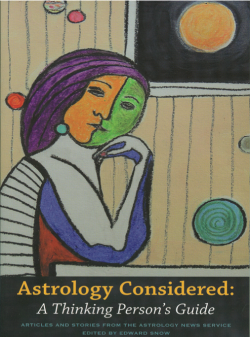
Astrology Considered

Astrology Considered

“…Enter Astrology Considered: A Thinking Person’s Guide, a compilation of articles from the Astrology News Service (ANS), an organization devoted to publicizing the true value of astrology. Astrology Considered offers a variety of perspectives on contemporary astrology that show astrology is not a simplistic system but a sophisticated way of viewing intrapersonal, interpersonal, and global dynamics. Happily, it is also an easy read for those who do not speak the sometimes-complex astrological language….”

I have immediately put this book on my Christmas Wish List, and will be sharing the details with my students when I meet with them next week. I do hope lots of you reading this post will follow the link above, and take advantage of a very special offer! And on a practical note, for UK readers the book is available now on Amazon UK, both as Paperback and Kindle Editions.  And many, many thanks to ANS for producing this wonderful-looking collection.

Zodiac

Zodiac

********

700 words copyright Anne Whitaker 2014

Licensed under Creative Commons – for conditions see Home Page

 

Honouring the Scorpio Solar Eclipse…

“……A poet very strongly rooted in the sign of  Scorpio, Dylan Thomas, talks about ‘deaths and entrances’. If we can face and grapple with our deepest attractions, compulsions, power drives, fears and repulsions, then we can experience – through staying with the struggle, seeking support where we can, having faith in the transformative dimensions of life – the symbolic death of aspects of the ‘old order’ holding us back from entry into a more complete and authentic expression of who it is we actually are…..”

Season of Scorpio

To read the rest of this post, click below:

http://anne-whitaker.com/2012/11/11/scorpios-season-a-meditation-on-darkness-power-and-poetry/

Zodiac

Zodiac

********

100 words copyright Anne Whitaker 2014

Licensed under Creative Commons – for conditions see Home Page
What are astrologers for?

Every so often, someone – usually an open-minded member of the public who has just found out what I do – asks me what my job as an astrologer is, and what the values and perspectives are are which I bring to my practice.  Here is my response. 

(Other astrologers may well have a different take on this topic. So – any practitioners, clients or students of astrology – or open-minded members of the public reading this – are most welcome to add their comments!)

Astrologer at Work

Astrologer at Work

My  job as an astrologer is to help other people understand themselves more clearly, in order to assist them in leading lives which they experience as being both fulfilling and useful. I don’t know what the balance is between fate and free will any more than any one else does. But the Birth Chart or Horoscope suggests strongly that we come into this world, not as tabulae rasae  (blank slates)  but with certain characters on the stage poised to live out a complex drama as the process of our life unfolds from birth to death.

Both astrologers and astronomers, via planetary observation, can look at and correctly plot the unfolding pattern of energies through space-time. After that, as an astrologer I step into a different realm than that of observation of the external, material, planetary world.

By looking at an individual’s horoscope, I can examine the essence of that moment in terms of its meaning, and then speculate with moderate accuracy about what some of the branches manifesting in that person’s life may be. Identifying the exact branches through which the energies symbolically represented by the planets in a horoscope may play out in the everyday world, is much more hit and miss.

Personally this cheers me, since it appears to suggest a creative balance between fate and free will in the universe; chaos theory in contemporary physics also has strong parallels with the astrological paradigm. Both the language of astrology and the language of quantum physics tells us that not everything  is pinned down.

Indeed, a view and a model are slowly emerging, despite considerable resistance from the diehard defenders of reductionism, which can demonstrate convincingly that the lenses of astrology and quantum physics are focusing on the same underlying, all encompassing Reality.

The perspectives offered by contemporary writers, astrologers, depth psychologists, and scientists, such as Richard Tarnas, Liz Greene, the late Charles Harvey, Stanislav Grof, Brian Swimme, Rupert Sheldrake, and others — including recent books by astrologers of the quality of , for example, Armand Diaz and Kieron Le Grice — have been of inestimable value to me in the last few years. I urge any readers of this blog who are keen to expand their own perspectives to explore those writers’ work.

My view, based on my personal experience as well as those of clients and students over more than 30 years, as well as extensive reading and study, is that the key dimension in determining how a particular planetary pattern will play out in a person’s life is the level of consciousness at which they are operating at the time the inevitable challenges of life come their way.

Most astrologers have had the humbling experience of looking at the horoscope of a client which looks so difficult that the impending consultation feels very stressful, but upon encountering the client, they meet someone who has faced, dealt with, and grown through hard experiences that would have flattened a less aware person.

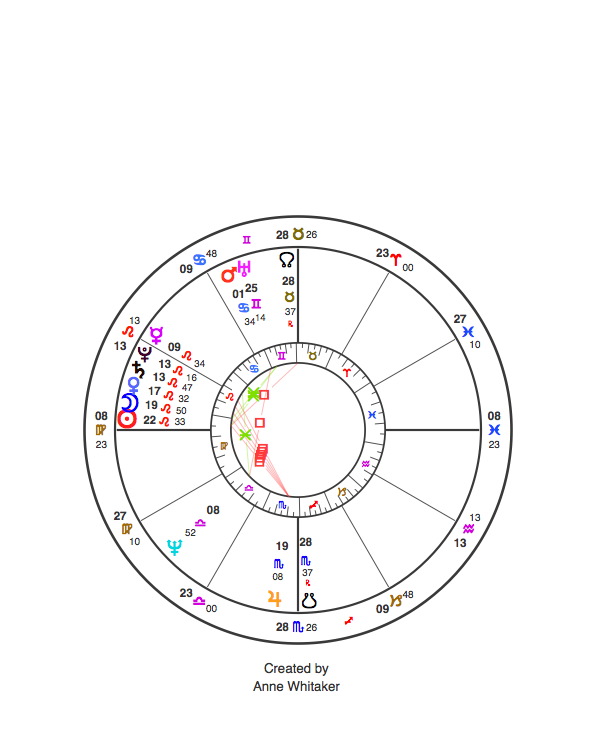
Anne W: Example Horoscope

Anne W: Example Horoscope

We can never predict the level of awareness of a client we have never met, although we can have a pretty good idea that, e.g., Mars conjunct Saturn conjunct Pluto square the Moon is going to be no walk in the park.

I am personally very hesitant about both the accuracy and the wisdom of predicting at all, especially for individuals, in any more than a “describing the core and speculating about the branches” kind of way. Predicting that a specific branch will manifest may well close down possibilities rather than open them up, which also takes us into the realm of self-fulfilling prophecy.

For example, when Uranus was about to cross my Pisces Descendant in 2005, beginning its seven or so years’ traverse of my 7th house, I became concerned about what this might mean for my marriage. The rather problematic implications of Uranus’ impact on the relationship realm that practising astrologers see every day in their students’ and clients’ lives, as well as their own, worried me.

However, a profound, totally unexpected spiritual experience on my husband’s part linked both our spiritual journeys into walking the same path at the same time. This has had a supportive, deepening effect on our marriage and not one I could possibly have envisaged before Uranus crossed my Descendant.

I think that effective astrologers in consultation are poised on the interface between fate and free will – on the one hand helping clients to confirm who they are, which they probably already know, if they are honest with themselves; but on the other hand helping them to see, and to broaden, the range of possible expression of the energies with which they have been born.

The astrologer’s ego should have a minimal influence on the process of reading another person’s Horoscope. It’s impossible to keep ego completely out of it. It’s impossible to be completely objective, to avoid making mistakes; but what the person takes away should be as much theirs, and as little the astrologers, as is possible.

To maximise this outcome I feel it is very important to have my work regularly supervised by an experienced and well-qualified colleague. I am fortunate in this to have  the support of a very experienced astrologer who is also a psychodynamic psychotherapist.

The main focus of my astrological work now is in vocational guidance, and in helping people who feel themselves to be on a developmental path which is rooted in whatever their sense of meaning may be, to gain an enhanced sense of clarity and perspective. Having been very much influenced by Buddhist philosophy in the last decade, in my own life I try to practice living in the present as effectively and mindfully as possible. ( Not easy…but well worth the effort!)

I’m only interested in working with clients who are prepared to take responsibility for themselves in relation to the way in which their inner world is connected to the unfolding of their outer life. Astrology appropriately used should enhance the sense of personal responsibility – not take it away and hang it on the planets, or even worse, on the astrologer !

In my view it is important for people not to become too dependent on a symbolic context – astrology and astrologers like relationships, drugs, sex, alcohol or the national lottery can become highly addictive. The great symbolic arts, eg astrology, tarot, palmistry , I Ching, should be consulted with deep respect, and with considerable restraint.

                    In sum – I think it is my job to send people away feeling more able to operate constructively and honestly in their world than when they came in, by supporting their courage and confidence to lead their own lives using their own judgement. 

However, I also consider it important to have a refer-on list of reputable therapeutic practitioners of varying disciplines, if it becomes apparent from our reading that the person consulting me needs some form of ongoing help. In assessing this, a long background as a counsellor as well as an astrologer I regard as being of immense help to me – and therefore, I hope, to my clients….

Zodiac

Zodiac

********

1300 words copyright Anne Whitaker 2014

Licensed under Creative Commons – for conditions see Home Page

TreeHouse interviews astrologer, writer and blogger Anne Whitaker

TH: What initially drove you to create the Astrology: Questions and Answers site at http://www.annewhitaker.com?

AW: Answering questions about astrology is something I have done both for my students and for myself for a very long time! Then a couple of years ago, I was invited to run an astrology blog from a popular local site here in Glasgow, Scotland, UK. I thought it would be fun to call it  Astrology: Questions and Answers, since by this time my astrological writings on Writing from the Twelfth House were attracting various kinds of correspondence via comments and emails from readers. Inevitably, questions were a big part! The local site proved too limiting, so I set up my own Astrology: Questions and Answers blog.

To read the rest of the interview, click HERE

TreeHouse

Zodiac

Zodiac

2o0 words copyright Anne Whitaker 2014
Licensed under Creative Commons – for conditions see Home Page
 

Are you feeling the pull of Neptune Retrograde?

I’m feeling extremely Neptunian today, as Neptune settles into its retrograde phase. Very spacy – not like my usual fairly grounded self. It’s a good day for creative writing, and I have a new project into which to sink: the metaphor would have to be watery, wouldn’t it?!

The mystical planet Neptune turned retrograde at 7.5 degrees of its own sign of Pisces yesterday, 9th June at 14.00 GMT, not turning direct again until mid-November. This is a subtle, deep time for all inner, reflective, imaginative, spiritual work. Take up meditation, writing poetry, listening to music: pay more attention than you normally would, to the hidden currents of your inner world, and see what comes to you as the months pass.

In the meantime, here is a beautiful evening image of the sea, Neptune’s realm…

Honouring Neptune

Honouring Neptune

…if you have any feedback to leave, concerning how Neptune’s retrograde turning this week is affecting you or yours, I’d love to hear from you. I’ve just been inspired – once the piece of work this week stimulated by Neptune is done – to go back through my diary for the last three years to research whether  I had as strong a reaction on previous occasions.

Watch this space! I’ll be reporting back.

Zodiac

Zodiac

200 words copyright Anne Whitaker 2014
Licensed under Creative Commons – for conditions see Home Page
Why is the zodiac sign of Virgo called the virgin?

Question:

 from  ThatHairlessBaby :

Why is the sign of  Virgo called the virgin?

My Answer:

This question raises the interesting issue of how the usage and meaning of words changes from one historical period/cultural phase to another. Within our current culture the word virgin when applied to humans generally means sexually intact. However, in ancient times when matriarchal religions were practised, the word virgin and the astrological sign of Virgo held a deeper and more complex set of meanings.

For example, the priestesses who served the ancient virgin goddesses Atargatis and Artemis were anything but virgin in our contemporary sense of the word. They were women who belonged to themselves and the goddess(es), whose duties to the temple were paramount and who owed allegiance to no particular male partner. Indeed,it was commonplace with those priestesses who had children to foster them out. They were too busy with their sacred duties to have much time for motherhood. (Virgo’s contemporary association with perfectionism, attention to detail, and devotion to work began a very long time ago!)

The eminent astrologer, writer and teacher Dr Liz Greene expresses the essence of what the sign Virgo is about in her “Astrology of Fate” p 215:

“….this issue does not deal solely with sexual matters, but embodies an entire view of life….I would understand it more as an openness to the flow of life, a willingness to trust the natural order, an acceptance of penetration and change….”

In the chapter “Myth and the Zodiac, pp 211-220, Liz Greene offers a very full account of the complex, paradoxical mythology and symbolism connected to the sign of Virgo. I commend it to you!

If you’d like to read some more factual aspects of this topic, try this Wikipedia link: http://en.wikipedia.org/wiki/Virgo_(astrology).

Thanks for your stimulating question!

Many thanks to my increasing band of new visitors, Followers and commenters out there. Drop by with your observations….. and, of course,  your Questions !

Zodiac

350 words copyright Anne Whitaker 2013

Licensed under Creative Commons – for conditions see Home Page of Writing from the Twelfth House

Ophiuchus – is there a thirteenth sign?

Sheilagh’s Question: Who the heck is Ophiuchus?

I’m surprised you’ve never heard of the constellation of Ophiuchus, Sheilagh. Ever since I’ve been an astrologer, every few years when they have nothing better to do, the media decide to indulge in a bit of Sun Sign astrology-bashing.They announce that astrology has been totally discredited by the existence of a thirteenth sign, ie Ophiuchus, the serpent bearer.

Here is a fairly mild offering: ( note the misspelling of Sagittarius….) http://newsfeed.time.com/2011/01/13/ophiuchus-what-all-saggitarius-and-capricorns-need-to-know-about-their-new-zodiac/

Now, here are some astronomical facts:http://en.wikipedia.org/wiki/Ophiuchus

Ophiuchus is one of thirteen constellations that cross the ecliptic. It has therefore been called the ’13th sign of the zodiac’. However, this confuses sign with constellation.

The signs of the zodiac are a twelve-fold division of the ecliptic , ie the 360 degree great circle in the heavens against which the planets are plotted in their orbital paths.Each sign spans 30° of that great circle, approximately the distance the Sun travels in a month, and (in the Western tradition) is aligned with the seasons so that the March equinox falls on the boundary between Aries and Pisces.

Constellations, on the other hand, are unequal in size and are based on the positions of the stars. The constellations of the zodiac have only a loose association with the signs of the zodiac, and do not in general coincide with them. In Western astrology the constellation of Aquarius, for example, largely corresponds to the sign of Pisces. Similarly, the constellation of Ophiuchus occupies most of the sign of Sagittarius.

 So now you know!

AND – New visitors and Followers out there! Do drop by with your observations….. and, of course,  your Questions….on any astrological topic.

Zodiac

Zodiac

250 words copyright Anne Whitaker 2013

Licensed under Creative Commons – for conditions see Home Page of Writing from the Twelfth House